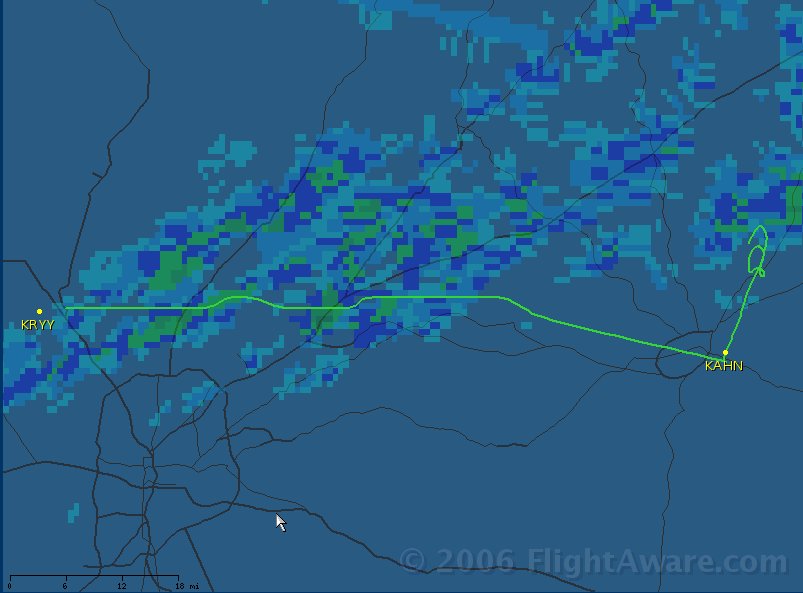
Friday, February 17, 2006

Athens, GA


The objectives of the flight: 1) Practice Pilot for an Instrument Pilot, 2) Practice a non-precision approach, 3) go some place different.

The weather has been somewhat unstable. Ceilings and visibility are OK, but temperatures have been warm and winds gusty. Our original plan was to go west to KPLR, but after reviewing the METARS, Airmets and Pireps we decided to go east and avoid some turbulence. A series of low pressure areas and a polar cold front was slowly moving just northwest of us stirring things up.

Athens (home of UGA) is about 75 miles from McCollum so would work for his x-country time. We also planned to come back to Winder (KWDR - Spitfire Grill) switch seats, go up to Gilmer (KGVL - Lake Lanier) and finally home. This would roughly split the time and if running late, I still have my night currency.

The oil was a bit low so preflight took longer then expected. Groundwork was all normal and we took off about 4:30. Fairly good winds out of the south, but only a little turbulence. He but the foggles on and headed roughly east climbing to 5,500. Visibility was good, about 8 miles in haze. Interesting for me as we flew by a number of out lying airports a portion of metropolis Atlanta. We listened to various common traffic frequencies, tuned radios and in general practiced x-country procedures.

We immediately noticed that the GPS was setup for 'Track Up". Both of us prefer "North Up". It took me a minute to remember that this correction is found by pressing the Menu button, using the Map Options to change the settings.
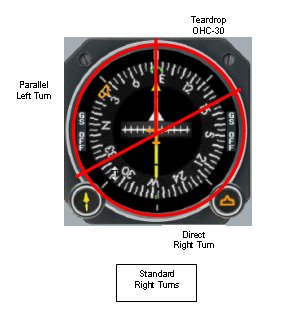
The next task was to enter holding for the RNAV20 approach. I was taught to divide the directional gyro into three quadrants. For a standard pattern (right turns), 70 degrees to the right for a teardrop entry, 110 degrees to the left for a parallel entry, and the remaining 180 degrees for a direct entry. Find the Outbound Holding Course (OHC) on the DG, see what sector its in and make the appropriate turn passing the holding fix. (Time, twist, turn, time, transition, talk). However, does GPS change this? You can see the holding pattern on the display, so is it really necessary to pass the holding fix for entry, or can you just turn onto the purple line and continue with the approach?
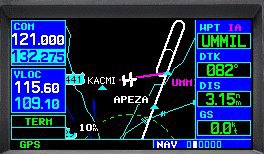
He completed the procedural turn (holding) and headed inbound. Athens is a towered field and there was one other plane in the pattern for Rwy27. However he was well clear by the time we passed the Final Approach Fix (FAF). The PIC started his descent late and never really got down to the MDA, so we executed a low approach, made a left turn for a downwind entry into the traffic pattern. An uneventful full stop landing allowed us to taxi over to the tower to stretch our legs and change seats.

Startup, taxi and runup were all normal. Winds had subsided so my takeoff was smooth and subsequent climb to 4000 was uneventful. However we we running a bit late so decided to forgo Gilmer and just head for home. Upon level off I contacted Atlanta approach and requested vectors to KRYY. They were not too busy, but there was another aircraft with a similar call sign. Very smooth air, but haze obscured our vision looking west and made for a beautiful sunset.

The low voltage light came on, rats. The procedure is to turn off the avionics switch and cycle the master. This plane has a digital voltage gage in addition to the discharge meter, and it showed we would lose 2 tenths of a volt, gain a tenth, etc. Slight discharge was showing. I was about 30 minutes out. hmmmm. Cycled strobes, checked breakers, no help.

Well, I decided to let it be. Monitored closely, but decided it would be OK for now. I did feel better when we called the field in sight. Contacted tower for a straight in, and made a 'squeaker' night landing.

We traveled 208 miles, climbed to 5757ft and reached 154mph over the ground.

C172p
Time = 2.3


Friday, February 10, 2006

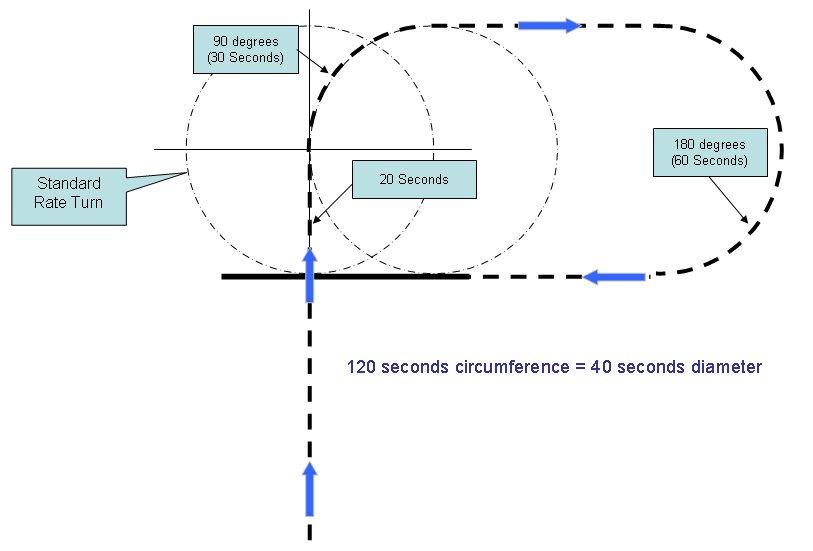
Better Circling with Math


I read an article in this months IFR Magazine (Feb 06) by Alan Jeffs describing his method to determine a circling approach. I think this looks pretty good, but would like to hear from the more experienced aviators out there. (Modfications suggested by John.)

How do you do it?

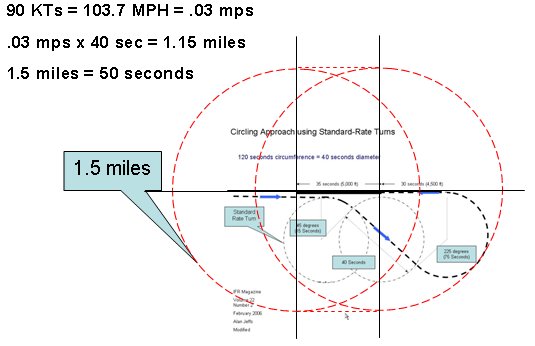
Extrapolating on the theme, how about this for a VOR A type approach?


It was pointed out that staying within 1.5 miles of the airport should be a serious consideration. While not to scale, the approximate diameters indicate that this is a valid concern and should go into the planning, along with corrections for wind. (Thanks again John, for the clarification.)


Thursday, February 9, 2006

The Right Seat


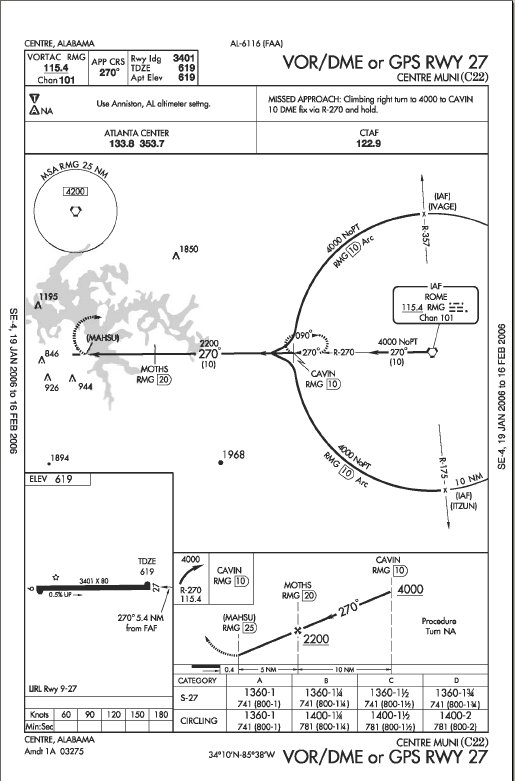
Objectives of this flight: Safety Pilot. My job was to look outside and insure we stayed clear of clouds and other aircraft. The PIC had chosen to fly to C22 (Centre Muni) in Alabama, shoot a VOR DME (arc) approach, over to Rome for the ILS 01 and then back home via vectors for the ILS27.

It was a beautiful afternoon. A high pressure area was located just west of us pushing a cold front through earlier in the morning. Good visibility, few clouds and haze, but the winds were supposedly gusting up to 18kts. Forecast said the winds would be diminishing throughout the evening.

We met in the flight office at about 3:30, briefed the flight, discussed what duties he wanted me to perform and decided a VFR flight plan would not be needed. Normal preflight, startup, taxi, and runup. A little gusty on takeoff, but not too bad, he climbed 4500 heading west. Smooth air, nicer then forecst, sun in our faces, we flew right by Cedartown (A4) while listening for traffic. The First chore was to intercept the arc at ITZUN, arc around to the west and north for the final approach course of 270 into C22. The GPS makes the arc work really simple, and he did a good job staying ahead of the needles. He had a bit of a late start on the descent, made good corrections, but still ended up high on final and decided on a low approach and go around. Full stop was uneventful. It is a nice little airport and we saw no other traffic.

All checks normal, we left there heading for Rome. He used the GPS to fly to KAREL (IAF), standard holding patten with a direct entry for the procedural turn and started inbound. A Citabria was in the pattern doing T&Gs, so my job got a bit busier. We spotted each other in plenty of time and he graciously took interval on us as we went down to mins and executed the missed back to the RMG VOR.

Next job was to get radar vectors for the ILS back home. Atlanta approach was busy. It took a few minutes, but we finally got our squawk. There was at least one other aircraft with a similar call sign, so we both had to listen carefully for instructions. We decided it would be best for him to take off the foggles to give us another pair of eyeballs looking for traffic. Also, the sun was at a low angle and the haze was thick enough to really obscure everything when looking west. It was a tight approach, final vectors called for a sharp turn to capture the final approach course just at AKONE (Final Approach Fix). He did well keeping up with it, made a nice approach and a beautiful landing.

What a great way to spend an afternoon! We went 194 miles, reached 148 mph and climbed up to 4613 ft.


C172P
Time = 2.1

Thursday, January 26, 2006

Into the Class B

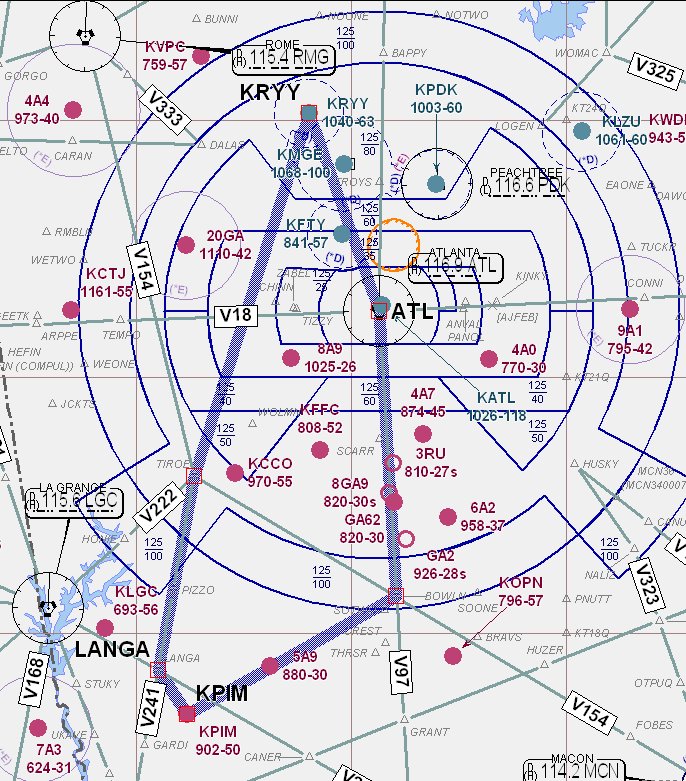
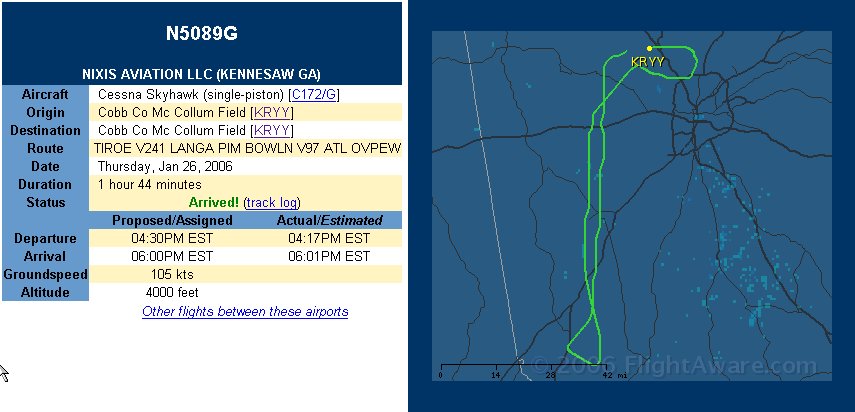
Objective of this flight: Get away from the patch and work the system. The plan was to fly down to Pine Mountain (Calloway Gardens) KPIM, shoot a GPS approach, come home over Atlanta for ILS 27 at McCollum (KRYY). We used to call them TCAs (upside down wedding cakes) reserved for the busiest of airports. While I've worked with Atlanta Center many times, this would be my first venture into the crowded airspace all by myself.

All the planning was done at home, my first time filing a flight plan from my home office. Weather was perfect VFR, not a cloud in the sky and very light winds. I got to airport just before 4:00, got the dispatch kit and went out to preflight. I had planned a 2130z departure, so had plenty of time to set up the radios. I expected a far different clearance from the one filed, so prepared myself to make the changes. To my surprise, I was cleared as filed, fly heading 260, climb and maintain 3000, expect 4000 ten minutes after. Cool.

Taxi, runup and takeoff were all normal. switched to departure, hit the ident button and waited. He was busy, but I always wonder how long to wait before reminding ATC that I'm waiting for radar contact. When he did contact me he had me turn to 180 and told me I would be on vectors down to PIM. (So much for the flight plan.)

This is GREAT stuff! Flying alone in Class B, talking to controllers, watching for traffic, just doing all of the 'stuff' I've been training to do.

I planned to do the GPS-A at PIM, which has an initial approach fix called JUKRU. I got a late frequency change and was passing the fix by the time Approach figured out what I wanted to do. No problem, I responded by going direct CARVA (Final Approach Fix) and playing the GPS to make it all happen. No problem on a clear day like this, I had the field in sight early and could easily have made the landing. Missed there and headed for home.

Again, the filed flight plan wouldn't work. Center didn't want me to fly directly over Hartsfield so I was told to go direct MIKEE. Ah, nice to have the GPS now, much easier to dial it in rather then find the defining navaids, set the radials and determine the correct intercept. A few minutes later I'm given vectors again, fly 360.

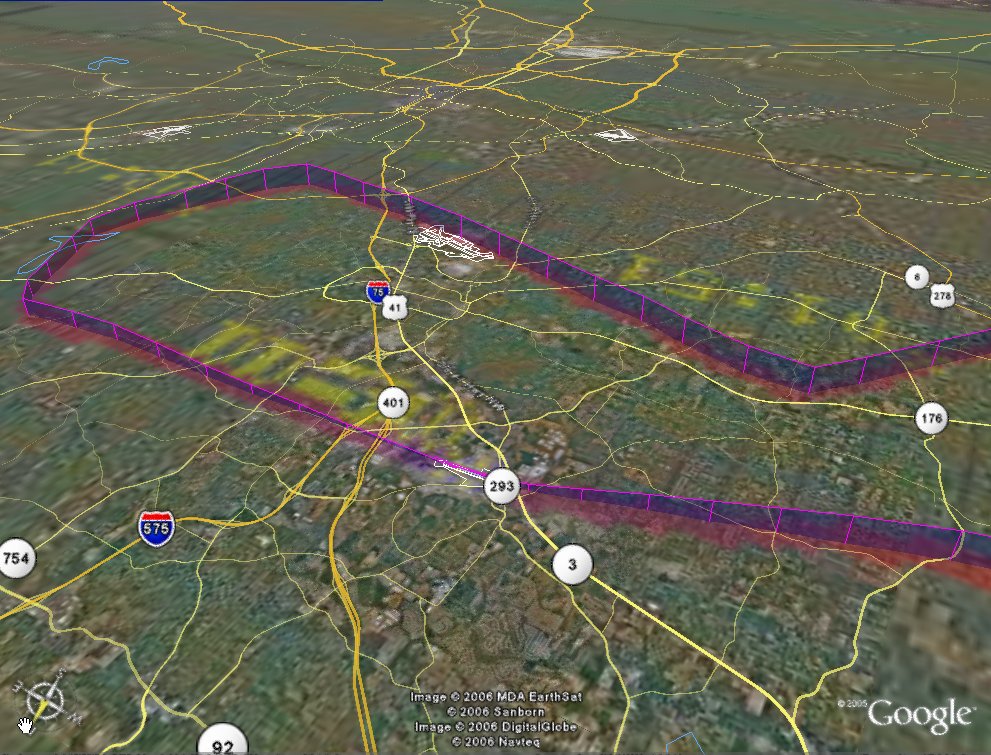
I asked for and was granted vectors for the ILS. Now this was really nice, as it took me directly over Dobbins AFB and close to downtown Atlanta. Very Cool! The rest of the approach and landing was uneventful. (Really easy when you can see the runway.) 215 miles, 5,090 feet and a max ground speed of 152 mph.

C172P
Time = 2.2 hrs

Thursday, January 19, 2006

Local Area Bounce

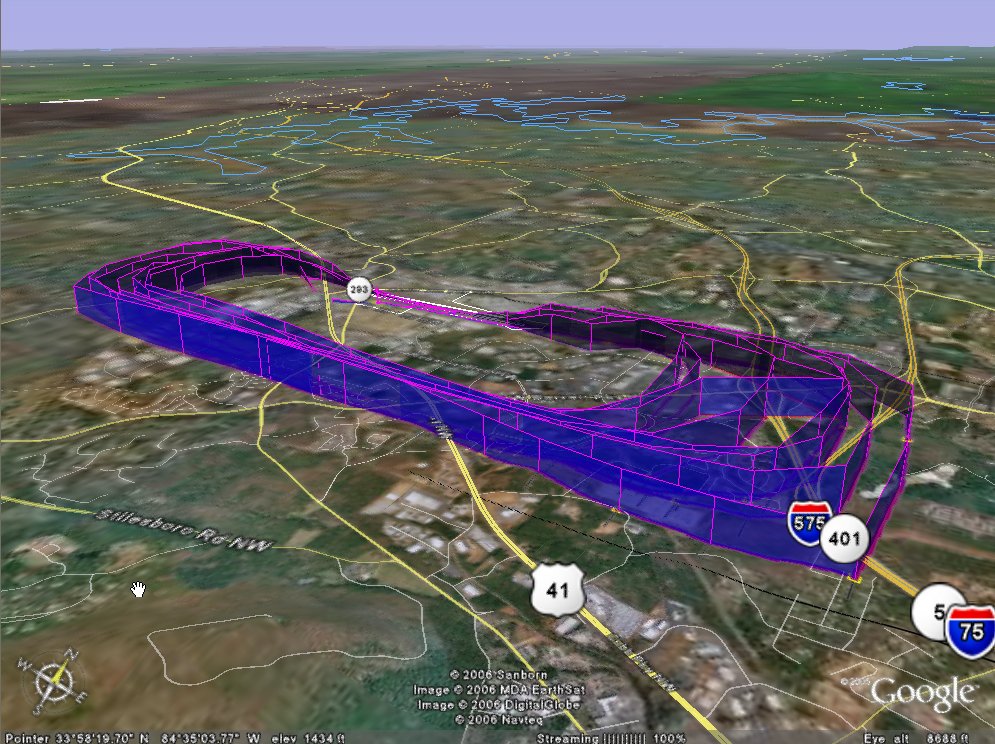
Objectives of this flight: Shoot some Touch and Goes. Instrument flying has been great, but my first love in aviation has always been the landings. That sweet squeak when the mains just kiss the asphalt and you feel the struts gently contract... well, if you don't know I can't explain it to you.

It's the middle of January and the temperature is in the mid 60's, clear as it gets and I have some money in my 'prepay' account. Got to the airport about 4:00. My CFI is sitting in lounge waiting for another student and asks where I'm going. After all this time and effort to get my Instrument ticket back, its hard to believe that I just want to go out and bounce.

Normal preflight, taxi and runup. Its busy today and I have to wait a few minutes before cleared for takeoff. The plane jumps into the air when no one is in the right seat. It has been awhile, no climb checklist since I'm staying in the pattern. (What are my settings and speeds?) It all comes back quickly. Tower calls, looking for traffic and making appropriate corrections for spacing comes easily now.

8 total, 4 good (3 great), 4 "OK" (1 salvaged...balloon), full flaps, half flaps, No flaps, and all with a mild (6-8kt) left crosswind. I had a smile on my face the whole time. "Peaceful", "At Home", "Comfortable" is how I would describe it.

Next time I'll have to wander away from the patch and go explore something, but today was a good day just to bounce.

C172P
Time = 1.1

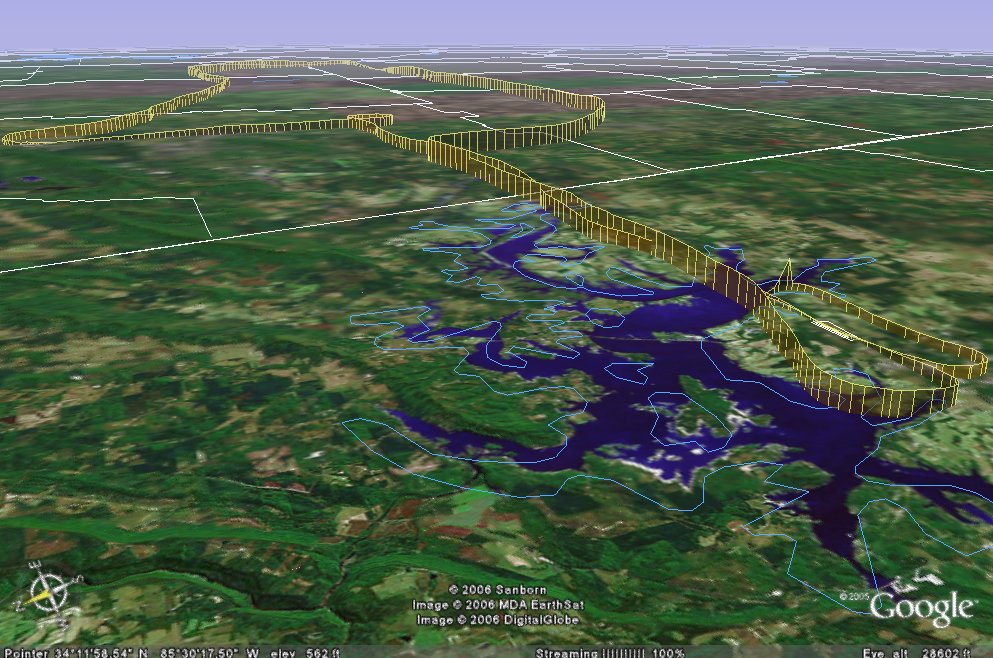
*the track was created using Magnalox. (#1152 'Local Bounce'.)